


How the price of a 3D print is calculated
The price of a 3D print can be calculated in several ways. These are the most common methods:
- Setup fee + (price per gram × weight in grams) = total price
- Lower setup fee + (price per gram × weight in grams) + hourly rate = total price
The first method focuses primarily on how much material is used, while the second focuses mainly on how long it takes.
The setup fee is a fixed amount you pay once per print file. This covers the time required to set up the printer, check your file, and start the print.
The material weight depends on how large your print is and how much infill is inside.
What is the average cost of 3D printing?
To give you an idea: most everyday prints cost between €5 and €45. A small object is around a few euros, while a large or technical part can go up to €90 or more.
There is no fixed catalog price because every object is different, but the factors that determine the price are straightforward. We explain them one by one below.
This affects the price of your 3D print
There is no fixed catalog price for 3D printing because every object is different. But the factors that determine the price are straightforward. These are the most important ones:
The print material
The material has the biggest impact on the price per gram. PLA is the most affordable and widely used material, suitable for most everyday applications. PETG is slightly more expensive but stronger and more moisture-resistant. Nylon with carbon fiber (PA12+CF15) is at the top of the spectrum: lightweight, extremely strong, and suitable for technical applications.
Not sure which material you need? Our material selection guide helps you make the right choice in just a few clicks.
The size of your print
The larger the object, the more material is required and the longer the print time. A small 5-gram keychain in PLA costs just a few euros. A large housing or scale model weighing 300 grams can easily cost between €40 and €80, depending on the material and settings.
Print quality (layer height)
A 3D printer builds an object layer by layer. The thinner the layers, the more detail, but also the longer it takes. The most commonly used layer height is 0.20 mm. If you choose 0.12 mm or 0.08 mm for more detail, the print time can even double. And more print time means higher costs.
Your print's density (infill)
A 3D print is not solid on the inside. The internal structure is called infill. At 15% infill, the print is already sturdy enough for most applications. If you increase the infill to 50% or 100%, you use more material and the print time increases; both factors raise the price of the print.
Supports (temporary structures)
Does your model have floating parts or sharp overhangs? Then supports are necessary: temporary structures that the printer adds so those parts don't hang in mid-air. They are removed after printing.
Supports cost extra material and processing time, which increases the price. A smart design without unnecessary overhangs saves money, request a free printability check if you're in doubt.
Post-processing
The price is for a ready-to-use print without extra finishing. Do you want to paint, sand, or coat the print yourself afterwards? Then you'll need to factor in your own material costs.
Most customers use their print exactly as it’s delivered. If you want to do your own finishing, our guides on smoothing a 3D print and painting a 3D print will help you get started.
How much does 3D printing cost per material?
These are the materials PixelPrints uses, from most affordable to most expensive:
- PLA: lowest price. The most commonly used material. Suitable for decorative objects, prototypes, and everyday indoor use.
- PLA Silk: same as PLA. Identical properties to PLA, but with a glossy, silky finish. Popular for gifts and decorations.
- PETG: slightly higher than PLA. Stronger and more moisture-resistant than PLA. The best all-round choice for functional parts.
- ASA: comparable to PETG. UV-resistant and weatherproof. The best choice for outdoor use.
- ABS: comparable to PETG. Resistant to higher temperatures. Suitable for technical indoor applications.
- TPU: higher than PLA. Flexible and rubber-like. For seals, protective cases, or parts that need to be springy.
- Nylon PA12+CF15: highest price. Carbon fiber-reinforced nylon. Extremely strong, lightweight, and suitable for demanding technical applications.
Realistic price examples
To give you an idea: these are common prints at PixelPrints with indicative prices.
- Small decorative object (~10 grams, PLA): € 5 – € 15. Think of a keychain attachment, small figurine, or small part. Quick to print, low material costs.
- Holder or clamp (~50 grams, PLA or PETG): € 15 – € 50. Think of cable holders, wall brackets, machine parts. Depends on material choice and complexity.
- Enclosure or functional part (~150 grams, PETG or ABS): € 25 – € 45. For electronics housings, technical parts, or larger protective covers.
- Large model or enclosure (~300 grams and up, PLA or ASA): € 50 – € 90+. Architectural models, large protective covers, or complete housings fall into this category.
These are indications; prices vary for every 3D printing service.
How much does a 3D printer cost?
Sometimes people aren't looking for the price of a print, but for a printer of their own. An entry-level model quickly costs € 200 to € 600, and the filament itself is around € 20 to € 35 per kilo. Then there are hidden costs: maintenance, time for calibration, and material lost to failed prints and supports.
For those who only need something occasionally—a replacement part, a prototype, or a gift—that investment rarely pays off. A print service is cheaper in that case, because you only pay for what you need, without the purchase price, learning curve, and waste.
When is 3D printing yourself cheaper?
Do you print more than a few times a month and are you willing to learn the technology? Then owning your own printer might pay off. You'll earn back the purchase price if you use it enough.
But even then, many makers choose a print service for larger volumes or specific materials they don't have on hand, such as carbon fiber-reinforced nylon or a high-quality UV-resistant ASA. You get the right machine and the right material without having to invest in them yourself.
No 3D file? Here is what modeling costs
Do you have an idea but no 3D model yet? We can have the model designed for you via our 3D modeling service. Based on your description, drawing, or photos, we will create a 3D print-ready file.
The costs for modeling vary depending on the complexity. If you combine modeling and printing in one order, you'll average € 50 to € 75 for a simple object.
How to save on 3D printing costs
You can easily manage the cost of a 3D print if you know which levers to pull. Here are a few practical tips:
- Choose PLA whenever possible. PLA is the most affordable material and works great for most indoor applications. Only opt for a more expensive material if the function or environment of your print really requires it.
- Lower the infill. For decorative or non-load-bearing parts, 15 to 20% infill is more than enough. Higher infill is only necessary if your print needs to withstand stress.
- Use the standard layer height. Unless you really need fine detail, 0.20 mm offers the best value for money. Finer layers look better but double the print time.
- Design without unnecessary overhangs. Supports cost money. A smart design with smooth curves and minimal overhangs requires little to no support. Not sure if your model is print-ready? Request a free printability check, and you'll hear what we think within 48 hours.
- Order smart. Need multiple parts? Order them all at once. That way, you only pay for shipping once.
Frequently asked questions about 3D printing costs
What is the average cost of 3D printing?
Most everyday prints cost between €5 and €45. A small decorative object will be a few euros, while a large or technical part can run up to €90 or more. The exact price depends on size, material, layer height, and infill.
How much does 3D printing cost per gram?
The price per gram varies by material. PLA is the most affordable, PETG and ASA are slightly higher, and carbon fiber-reinforced nylon is the most expensive. In addition to the price per gram, you pay a one-time setup fee per print file. You can see the exact amount per gram directly in our price calculator.
What is the cheapest material to print with?
PLA is the cheapest and most commonly used material. It’s perfect for decorative objects, prototypes, and everyday indoor use. Only choose a more expensive material if your print needs to withstand heat, moisture, UV light, or heavy loads.
Why does one print sometimes cost more than several together?
Setup costs apply per print file. If you order multiple parts at once, you share those fixed costs and only pay for shipping once. This often makes a larger order more cost-effective per piece.
Can I see exactly what my print will cost in advance?
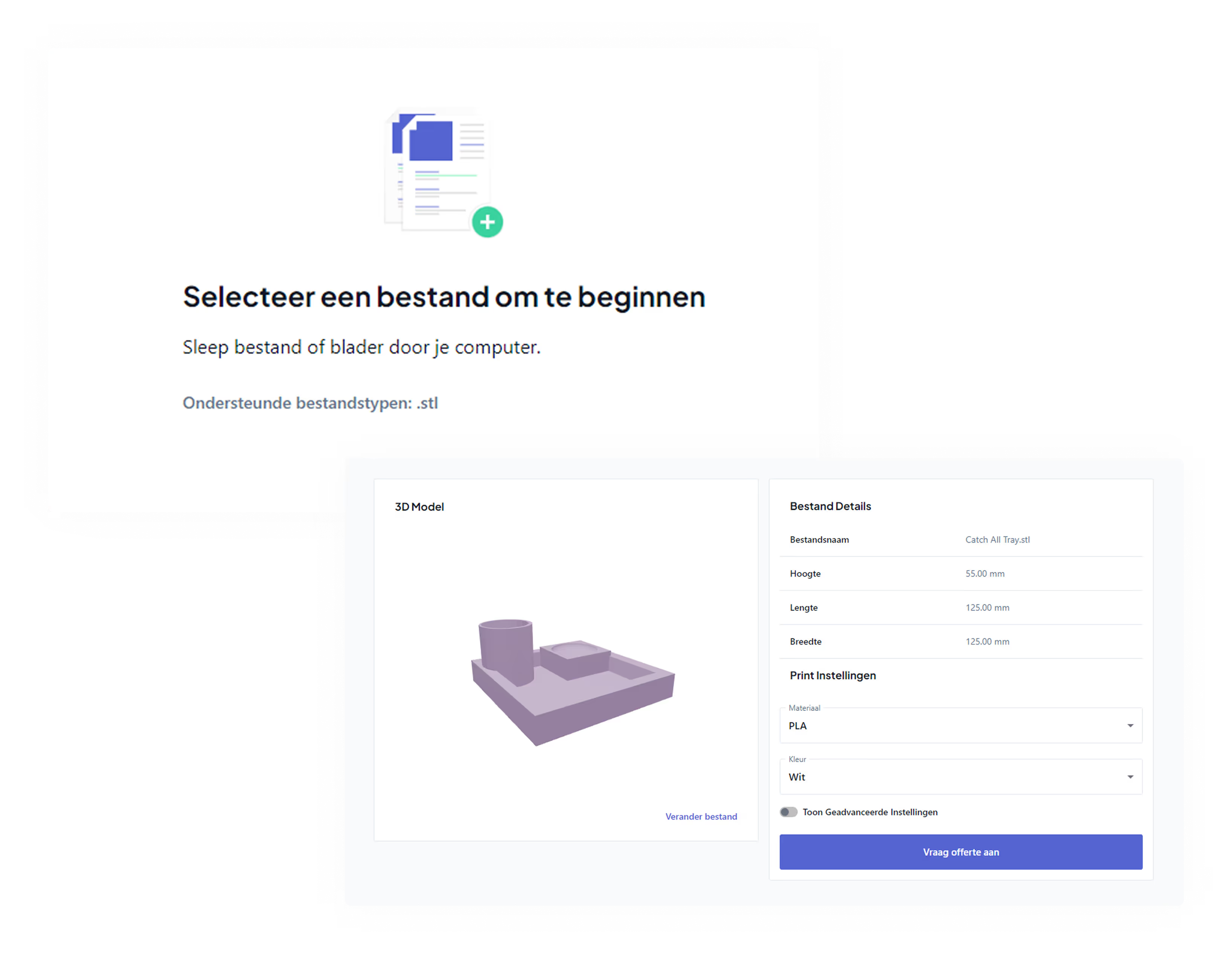
Yes. Upload your STL file into our price calculator and you will immediately see the total price, including your chosen material, layer height, and delivery time. Free and without an account.
Calculate the price of your 3D print now
Know what you want to print? Upload your STL file to our 3D print price calculator and see the price instantly, including material choice, layer height, and delivery time.
Don't have a 3D file yet, or not sure if your file is ready for printing? Request free advice. You'll hear back from us within 48 hours about how we can help.