


What is nylon filament?
Nylon filament is a synthetic polymer based on polyamide, hence the abbreviation PA. In the 3D printing world, "nylon" and "polyamide" are used interchangeably. They describe the same material.
Nylon was first developed in the 1930s and has since become one of the most widely used industrial plastics. You know it from clothing, gears, zip ties, and toothbrush bristles. That broad application is no coincidence: nylon combines strength, flexibility, and wear resistance in a way that most other plastics can't match.
For 3D printing, nylon is popular precisely because of those mechanical properties. It’s the go-to choice for functional parts that need to withstand stress, friction, or repeated movement.
Nylon variants: PA6, PA11, PA12, and PA12+CF15
The PA variant you choose makes a big difference, both in the behavior of the final product and in how easy the material is to print.
PA6: the most powerful, but also the most difficult
PA6 has the highest stiffness and tensile strength of the common nylon variants. It is widely used in industrial applications and machinery. The downside: PA6 is extremely hygroscopic. This means it absorbs moisture faster than any other PA variant, which makes the printing process sensitive. Even slightly damp filament will cause bubbles, a rough surface, and weaker layer adhesion.
For home or hobby use, PA6 is rarely the smartest choice. For industrial applications where mechanical performance is critical, however, it’s perfect.
PA11: the flexible, bio-based variant
PA11 is made from castor oil, making it the most sustainable nylon variant. It is more supple and flexible than PA12, with better impact resistance at low temperatures. This makes PA11 suitable for parts used in cold environments or those that need to withstand repeated bending forces without breaking.
PA11 is also less hygroscopic than PA6 (meaning it absorbs less moisture), which makes it slightly easier to print.
PA12: the most printable, the best all-rounder
PA12 is the most commonly used nylon variant for FDM 3D printing. The reason is practical: PA12 absorbs less moisture than PA6 or PA11, is less prone to warping, and is more dimensionally stable during printing.
That doesn't mean PA12 is easy—all nylon variants require dry filament and the right settings—but PA12 is the most user-friendly of the bunch. Mechanically, it is slightly less stiff than PA6, but for the vast majority of functional applications, that’s not an issue.
PA12+CF15: carbon fiber reinforced, for maximum performance
PA12+CF15 is PA12 with 15% short carbon fibers. Those fibers fundamentally change the material's behavior. The end result is stiffer, stronger, and lighter than standard PA12, with higher dimensional stability and a lower risk of deflection under load.
You do trade off some flexibility, though. PA12+CF15 is brittle compared to standard PA12 and is more prone to breaking under impact. This makes it great for rigid, load-bearing structures, but less ideal for parts that need to flex.
Practical tip: carbon fibers are abrasive. This means they wear down standard brass nozzles much faster. You’ll need a hardened steel or ruby nozzle for CF filaments, otherwise your printhead will degrade quickly.
Nylon filament properties
The properties that set nylon apart from other FDM materials:
- High tensile strength and wear resistance. Nylon is tough and stands up well to constant friction and mechanical stress. Gears, hinges, and sliding parts are classic applications where nylon is the clear choice over PLA or PETG.
- Slightly flexible. Nylon bends before it breaks. It deforms under pressure and springs back—a quality that PLA, ABS, and even PETG don't have to the same degree. This makes it perfect for clamps, fasteners, and parts that need to absorb vibrations.
- Chemical resistance. Nylon is resistant to oils, greases, gasoline, and many solvents. This is a huge advantage for parts used near engines or chemicals.
- Temperature resistance. The glass transition temperature (the point where the hard material starts to soften) for PA12 is around 80°C; PA6 goes a bit higher. That’s comparable to PETG and lower than ABS or ASA. For most indoor applications, this is more than enough.
- Hygroscopic, which is its biggest practical drawback. Nylon absorbs moisture from the air. Filament left out overnight will print differently than filament stored in a dry environment. You can even hear it—damp nylon crackles and hisses in the nozzle. The result is a rough surface, bubbles in the print, and weaker layers. You can prevent this by storing your nylon in a sealed dry box with silica gel. Dry it for at least 8–12 hours at 70–80°C before use.
The best nylon print settings
Getting nylon settings right is trickier than with PLA or PETG. Here are the recommended settings for PA12:
- Print temperature: 240–270°C. Start at 250°C and adjust based on the results. Too low leads to poor layer adhesion and a rough surface; too high can degrade the material or increase stringing.
- Bed temperature: 70–90°C. A heated bed is essential for nylon. Use a PEI print surface or garolite (FR4) for the best adhesion. Blue painter's tape works too, but it's less reliable.
- Print speed: 30–50 mm/s. Slower than PLA. Nylon needs more time to bond properly, especially on the first layers.
- Cooling fan: low or off. Too much cooling prevents proper layer adhesion. Use a maximum of 20–30% fan speed, and only after the first few layers.
- Infill: 20–40% for standard use. For mechanically stressed parts, 50%+.
- Layer height: 0.20 mm is the standard. Finer layers provide more detail but significantly increase print time.
- Enclosed chamber: highly recommended. An open printer allows for too many temperature fluctuations, which leads to warping and poor layer adhesion. Bambu Lab printers have an enclosed chamber that handles this well.
- The same settings apply to PA12+CF15, but always use a hardened nozzle; a standard brass nozzle will be worn down by the carbon fibers within a few hours.
Comparing nylon to other materials
Nylon vs. PLA
PLA is easier to print, cheaper, and biodegradable. However, it is more brittle, starts to deform at 55–65°C, and has low wear resistance. For decorative objects or prototypes without mechanical stress, PLA is fine. As soon as a part needs to withstand wear, bending forces, or higher temperatures, nylon wins on all fronts.
Nylon vs. ABS
ABS is stiffer than nylon but less wear-resistant and less flexible. ABS produces harmful fumes during printing and has a higher risk of warping. Nylon is the better choice for moving and wear-resistant parts; ABS is slightly preferred if stiffness is more important than flexibility. In most cases, nylon is the more modern and better choice.
Nylon vs. PETG
PETG is easier to print than nylon and has good chemical resistance. However, PETG is less wear-resistant and less suitable for mechanically stressed parts. If you are looking for moisture resistance or functional parts without heavy mechanical stress, PETG is a fine and easier choice. As soon as wear resistance or durable flexibility is required, go with nylon.
Nylon vs. ASA
ASA wins on UV resistance and weatherability for outdoor use. Nylon wins on abrasion resistance and mechanical durability indoors. The choice is simple: if it's for outdoors, choose ASA. If it's for mechanically demanding indoor applications, choose nylon. Read the detailed comparison in: nylon vs ASA.
When should you choose nylon?
Nylon is the right choice if one or more of the following apply:
- The part is subject to mechanical stress, such as gears, hinges, clamps, sliding parts, or fasteners that are frequently tightened and loosened.
- There is wear and tear involved, friction, constant movement, or contact with other materials.
- The part comes into contact with oils, greases, or fuels.
- You need a slightly flexible part that springs back instead of breaking.
Does none of the above apply? Then nylon is probably overkill. PETG or PLA are easier to print and cheaper for applications that don't have extreme mechanical requirements. Use our material selection guide if you're in doubt.
Frequently asked questions about nylon filament
Is nylon the same as polyamide?
Yes. Nylon is the brand name; polyamide (PA) is the chemical name. In the 3D printing world, both terms are used interchangeably and describe the same material. The abbreviation PA followed by a number, such as PA12 or PA6, indicates the specific variant.
Which PA variant is best for FDM 3D printing?
For most applications, PA12 is the best choice. It is the easiest to print, absorbs less moisture than PA6, and has excellent mechanical properties. Need maximum stiffness and strength? Choose PA12+CF15. Looking for flexibility at low temperatures or a more sustainable option? Go with PA11.
Why does nylon crackle while printing?
That’s moisture in the filament. Nylon absorbs moisture from the air, sometimes after just a few hours outside a dry box. That moisture evaporates in the nozzle, causing the characteristic crackling, bubbles, and a rough surface. Solution: dry the filament for 8–12 hours at 70–80°C before use and store it in a sealed dry box afterward.
Do I need a special printer for nylon?
At the very least, you need an all-metal hotend, as standard PTFE-lined hotends cannot handle the high temperatures required for nylon (240–270°C). A heated bed and preferably an enclosed chamber are also necessary. A printer like the Bambu Lab X1 Carbon, which we use at PixelPrints, is specifically designed for technical materials like nylon.
Can I use nylon outdoors?
Nylon is resistant to oils and chemicals, but it is not UV-resistant. Prolonged exposure to direct sunlight can cause nylon to discolor and degrade. For outdoor use, ASA is a better choice.
Is PA12+CF15 stronger than standard PA12?
In terms of stiffness and dimensional stability: yes. PA12+CF15 is stiffer, holds its shape better under load, and is lighter by volume. However, in terms of impact resistance and flexibility: no. The carbon fibers make the material more brittle, so it is more likely to break under a hard impact than standard PA12. Choose CF for rigid structures; choose standard PA12 for parts that need to absorb impacts or bending forces.
Get your nylon parts printed at PixelPrints
Printing nylon yourself requires a suitable printer, dry storage, and the necessary experience with settings. At PixelPrints, we print with PA12 and PA12+CF15 daily on Bambu Lab printers with hardened nozzles—exactly the material and setup these prints require.
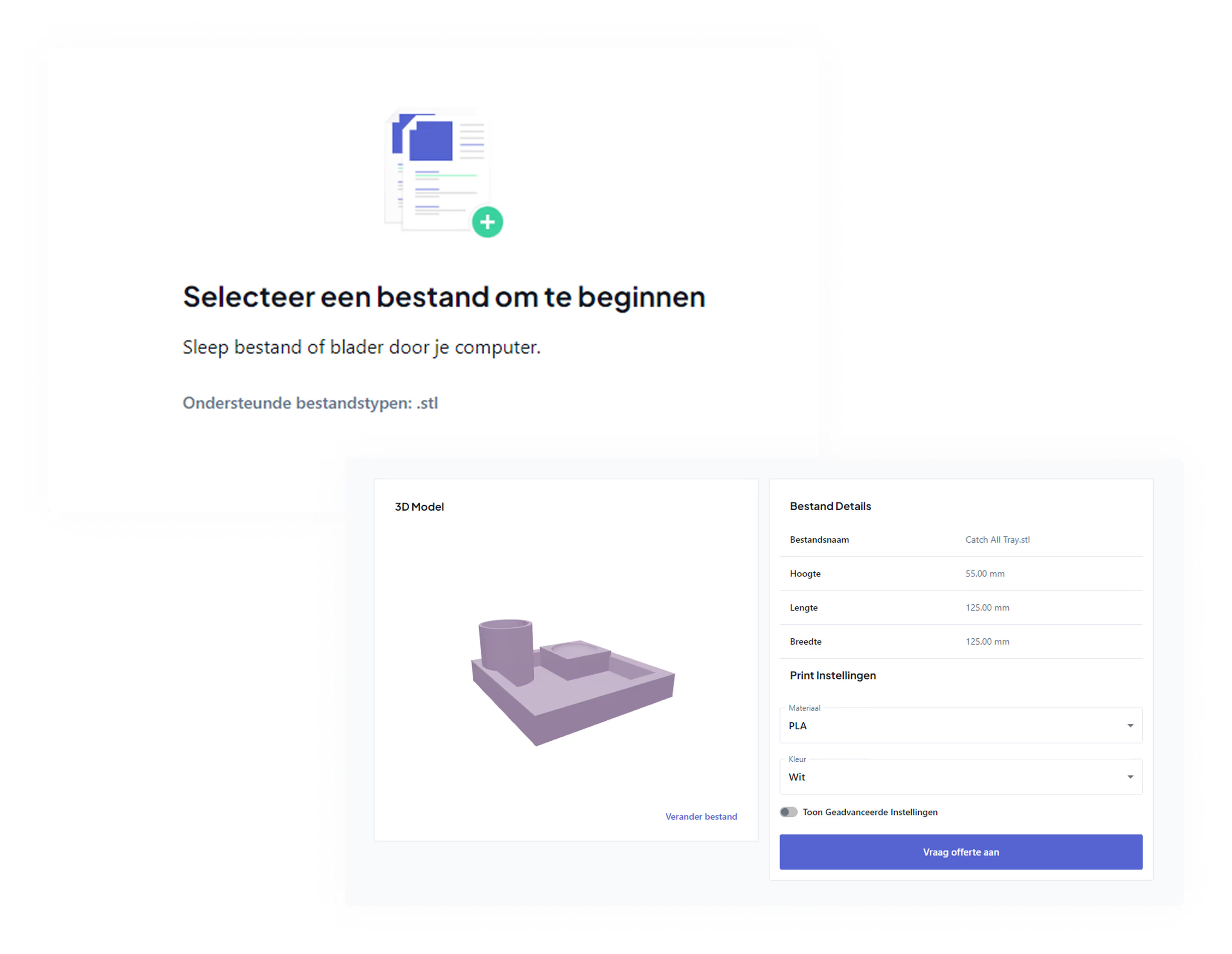
Upload your STL file to our 3D print price calculator and select nylon as your material. Not sure which material is right for your application? Use our material selection guide or request a free printability check on.
No file? Through our 3D modeling service we'll design the model for you.