


What is PLA filament?
PLA stands for Polylactic Acid. It is a bio-based plastic made from renewable resources like corn starch, sugarcane, or cassava. This makes it different from most other plastics, which are petroleum-based.
For 3D printing, PLA is processed into filament: a 1.75 or 2.85 mm diameter strand that is melted in the printer and built up layer by layer into an object. PLA melts at relatively low temperatures, around 190–220°C, making it easy to process and suitable for almost any FDM printer.
PLA is not toxic. At normal printing temperatures, no dangerous substances are released in harmful concentrations. Small particles are emitted, however. That’s why, just like with any heated plastic, it’s important to ventilate well. But PLA is considered one of the safest FDM materials to print with, even indoors.
What is PLA made of and is it biodegradable?
PLA is made from plant-based starch sources, primarily corn. That sounds sustainable, and compared to oil-based plastics, it is—at least during the production phase. But the claim that PLA is "biodegradable" requires some context.
PLA does break down, but only under the right conditions: high temperatures (55°C+), sufficient moisture, and the presence of specific microorganisms. These are the conditions found in an industrial composting facility, not in your garden or trash can. In a normal environment, it takes decades for PLA to fully break down, similar to regular plastic.
So, while PLA is bio-based and biodegradable in theory, in practice, you should treat it like any other plastic. Don't just throw it away; check if there is a recycling option in your municipality.
Properties of PLA filament
PLA has a combination of properties that makes it the popular standard choice:
- Easy to print. PLA adheres well to the print bed, suffers little from warping, and doesn't require special settings or an enclosed printer housing. The ideal print temperature is between 190–220°C. A heated bed is useful but not mandatory.
- Stiff but brittle. PLA is stiff and barely deforms under pressure, but it is more likely to snap than bend upon hard impact. This is great for dimensionally accurate parts, but less suitable for components that need to absorb shocks.
- Limited temperature resistance. The glass transition temperature (the point at which it softens) for PLA is around 55–65°C. This means a PLA object can deform in a hot car, in direct sunlight, or near a heat source. For a figurine on your desk, that's no problem; for a part under the hood or on an outdoor facade, it is.
- Not waterproof, but moisture-resistant for light use. PLA absorbs little moisture, but an FDM print is never hermetically waterproof; the layers have microscopic gaps. For a vase holding water, PLA works fine if the walls are thick enough. For something that is constantly wet or under pressure, you're better off choosing PETG.
- PLA is easy to post-process. Sanding, painting, and varnishing are straightforward. It bonds well with acrylic paint. Want a smoother surface? Sanding with progressively finer sandpaper (200 → 400 → 800 grit) will give you a sleek result.
Gluing PLA: here is how you do it
PLA is easy to glue. The most common methods:
- Super glue (cyanoacrylate) is the fastest and easiest option. It works well for small surfaces and non-load-bearing joints. A downside is that the bond is brittle under impact.
- Two-part epoxy provides a stronger and more impact-resistant bond than super glue. It is ideal for larger surfaces or joints that need to bear weight. The drying time is about 5–60 minutes, depending on the type.
- Bonding PLA with a 3D pen works well if you want to fill and reinforce the joint. Melt a little bit of PLA filament into the seam; this creates a solid bond that moves with the material.
- For the best results: lightly sand the surfaces to be glued for better adhesion, and degrease with isopropyl alcohol before gluing.
PLA variants: which ones are there and when should you choose which?
Standard PLA is the baseline. But there are variants that add specific properties, and it is useful to know them.
PLA+ is stronger and less brittle
PLA+ (also known as PLA Plus) has higher impact strength and is less brittle; it flexes slightly before breaking instead of snapping immediately. Printability is similar to standard PLA.
You choose PLA+ if the part is under light mechanical stress or needs impact resistance, but you still want to stick with the ease of PLA. Do you want truly functional, wear-resistant parts? Then PETG or nylon are better choices.
PLA Silk: for the shine
PLA Silk has a glossy, silky finish that looks like metal or satin. Its mechanical properties are similar to standard PLA, so it is not stronger. The added value is purely aesthetic: it creates a beautiful result for decorative objects, figurines, gift items, and jewelry.
PLA CF: carbon fiber reinforced
PLA CF (Carbon Fiber) contains short carbon fibers that make the material stiffer and lighter. It has a matte, technical look. A downside is that it is more brittle than standard PLA and requires a hardened nozzle. The carbon fibers wear down a standard brass nozzle quickly.
PLA CF is a good choice if stiffness and appearance matter, but you don't expect heavy mechanical stress. For serious technical applications, you should quickly look at nylon PA12+CF15.
Other variants
There are dozens of other PLA variants: matte PLA, wood-filled, marble effect, glitter, transparent, and color-changing. These variants are purely about aesthetics. Printability is similar, and the mechanical properties don't change much. Choose based on how you want the final product to look.
Comparing PLA to other materials
PLA is the starting point, but not always the final destination. Here is when to switch:
PLA vs PETG
PETG is stronger, more moisture-resistant, and more heat-resistant than PLA. It is slightly trickier to print but still very manageable. Choose PETG when your part is used functionally, comes into contact with moisture, or is exposed to higher temperatures (above 60°C).
PLA vs ABS
ABS is more heat-resistant than PLA but more prone to warping and produces harmful fumes. In most cases, PETG is a better and safer choice than ABS. PLA beats ABS on printability; ABS wins on heat resistance.
PLA vs ASA
ASA is UV-resistant and weather-resistant, making it the clear choice for anything kept outdoors. PLA degrades with prolonged exposure to sun and rain. Is your print going outside? Don't use PLA.
PLA vs nylon
Nylon is more wear-resistant, flexible, and mechanically stronger than PLA. For gears, hinges, and parts subject to daily friction, nylon is the right choice. PLA is not an option here.
When is PLA the right choice and when is it not?
PLA is the right choice if:
- The print is kept indoors and won't be exposed to high temperatures.
- It won't be subjected to heavy mechanical stress or wear and tear.
- It needs to look good, as PLA provides a clean, smooth finish.
- You want it fast and without any hassle.
PLA is the wrong choice if:
- The object is kept outdoors or in direct sunlight.
- Temperatures above 60°C might occur, such as in a car during summer or near a lamp.
- The part is under mechanical stress, needs to bend without breaking, or is subject to friction.
- Contact with moisture is a strict requirement.
Still not sure? Use our material selection tool, which asks you a few questions and gives you an instant material recommendation.
Get something printed in PLA at PixelPrints
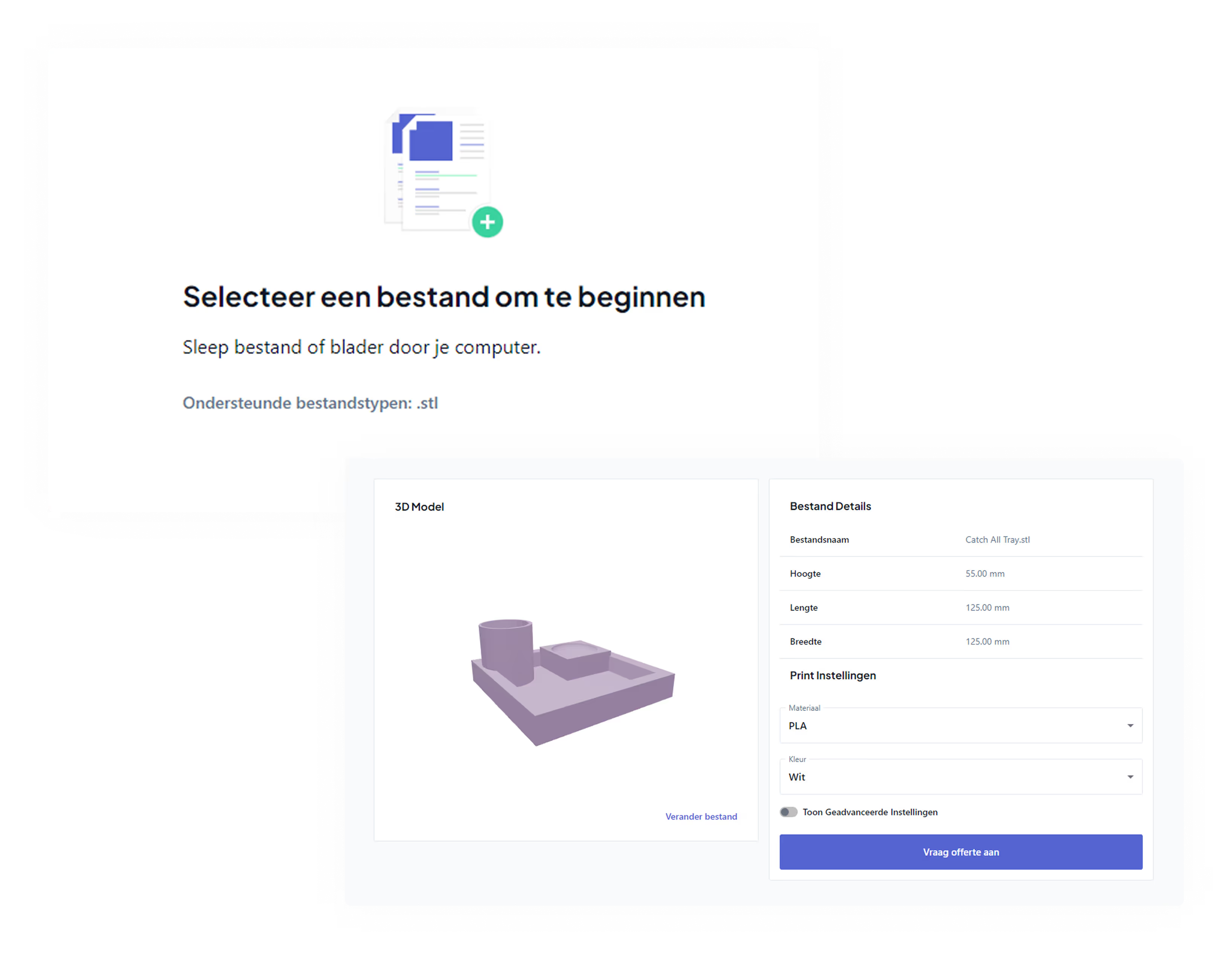
PLA is available as a standard material at PixelPrints, including PLA Silk. Upload your STL file to our 3D print price calculator and calculate the price instantly. No account required, pay via Stripe, delivered within 5 business days.
Don't have a 3D file but have an idea? Through our 3D modeling service we can design the model for you.
Not sure if your file is ready for printing? Request a free printability check on.